RNA doesn’t just carry genetic instructions—it also interacts with proteins to regulate nearly every aspect of gene expression, from splicing to translation. When those interactions go awry, the consequences can be devastating. In myotonic dystrophy type 1 (DM1), the most common adult-onset muscular dystrophy, a toxic RNA repeat expansion hijacks a critical protein called MBNL1, trapping it in nuclear clumps called foci. This leads to widespread splicing defects and progressive muscle wasting. But studying these toxic interactions inside living cells—and finding small molecules that can disrupt them—has been a significant challenge.
A recent study led by the Scripps Institute may have a solution. The study introduces a NanoBRET™ assay that can monitor the interaction between the expanded CUG RNA repeats and MBNL1 protein in real time, in live cells. Their findings demonstrate how this platform can be used not only to detect disease-driving RNA–protein complexes but also to identify small molecules that break them apart.
The Problem: A Toxic RNA Trap
In DM1, the DMPK gene contains an expanded trinucleotide CUG repeat in its 3′ untranslated region. When the repeat exceeds roughly 50 copies—and in patients, it can reach into the thousands—the RNA folds into a structure studded with repeating UU internal loops. These loops are high-affinity binding sites for MBNL1, an important regulator of alternative pre-mRNA splicing. Multiple copies of MBNL1 bind along the expanded repeat, becoming sequestered in nuclear foci and unable to perform their normal function. The result is dysregulated splicing of many downstream targets, driving the muscle weakness and other symptoms seen in DM1.
Existing methods for studying RNA–protein interactions, such as cross-linking immunoprecipitation (CLIP), are powerful but often require laborious workflows performed outside of living cells. This makes it difficult to capture the dynamic, transient nature of these interactions in their native cellular context.
The Solution: A NanoBRET Assay for RNA–Protein Interactions
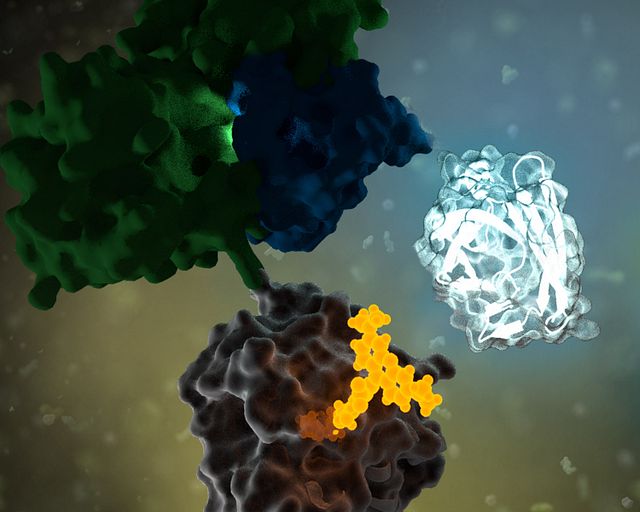
To overcome these limitations, the researchers designed a clever live-cell assay using NanoBRET™ technology. The concept takes advantage of the fact that expanded CUG repeats bind multiple copies of MBNL1 simultaneously. By fusing MBNL1 to two different tags—NanoLuc® luciferase and HaloTag®—the team created a system where the toxic RNA acts as a scaffold, bringing the two tagged proteins close enough together to generate a bioluminescence resonance energy transfer (BRET) signal. When a small molecule or antisense oligonucleotide disrupts the RNA–protein complex, the tagged proteins separate, and the BRET signal drops.
Screening for Small Molecule Disruptors
First, the team validated the assay with two types of antisense oligonucleotides. Both produced dose-dependent reductions in the NanoBRET signal. With the assay validated, the researchers screened a focused library of 72 RNA-binding small molecules. The screen identified ten compounds that significantly reduced the NanoBRET signal.
To determine whether these molecules were acting on the RNA or the protein, the team used differential scanning fluorimetry and NMR spectroscopy. The results clearly showed that most compounds bind directly to the UU internal loops of the CUG repeat RNA, with minimal interaction with MBNL1 itself. This is an important distinction, since binding to MBNL1 could inadvertently worsen splicing defects by interfering with its normal function.
From Hits to Phenotype Rescue
Next, the researchers wanted to know: Can these candidate compounds improve disease-relevant phenotypes? To answer this, they evaluated the compounds in DM1 patient-derived myotubes, looking at two hallmarks of disease: aberrant alternative splicing of MBNL1 exon 5 and formation of nuclear foci.
Six of the ten hit compounds rescued the MBNL1 exon 5 splicing defect in a dose-dependent manner. Crucially, the active compounds had no effect on splicing in wild-type myotubes, supporting their specificity for the disease mechanism. Four compounds significantly reduced both the number and intensity of MBNL1-containing nuclear foci in patient-derived cells, consistent with displacement of MBNL1 from the toxic RNA.
Looking Ahead
This study demonstrates that NanoBRET™ technology, originally developed to study protein–protein interactions, can be successfully adapted to monitor RNA–protein interactions in living cells. The platform provides a quantitative, high-throughput-compatible readout that captures the complexity of these interactions in their native cellular environment—something that traditional biochemical methods often miss.
The researchers note that similar assays could be developed for other RNA repeat expansion disorders where different repeat sequences sequester different RNA-binding proteins. The assay is also sensitive to changes in RNA abundance, meaning it should be compatible with emerging therapeutic strategies that aim to degrade toxic RNAs directly.
For the DM1 field, this work provides both a powerful new tool and a promising set of small molecule leads. Much optimization remains before any of these compounds could become a therapy, but the ability to screen for disruptors of toxic RNA–protein interactions in live cells is an important step forward.
Learn more about NanoBRET™ Technology and its applications in studying molecular interactions in live cells!
Reference: Shan, J. et al. (2025) A Live-Cell NanoBRET Assay to Monitor RNA–Protein Interactions and Their Inhibition by Small Molecules. ACS Cent. Sci.11, 2154–2171.

Latest posts by Johanna Lee (see all)
- A Live-Cell NanoBRET Assay Shines Light on Toxic RNA–Protein Interactions in Myotonic Dystrophy - February 26, 2026
- Your Science in Review: Our Top Blogs of 2025 - December 30, 2025
- Polyserine Targeting: A New Strategy Against Neurodegeneration - September 30, 2025