Sarah Mahan embraces change. In fact, she doesn’t just embrace it, she seeks it out, running towards change with arms wide open.
“If I could do a different thing every week, I would. That’s what my job would be.”
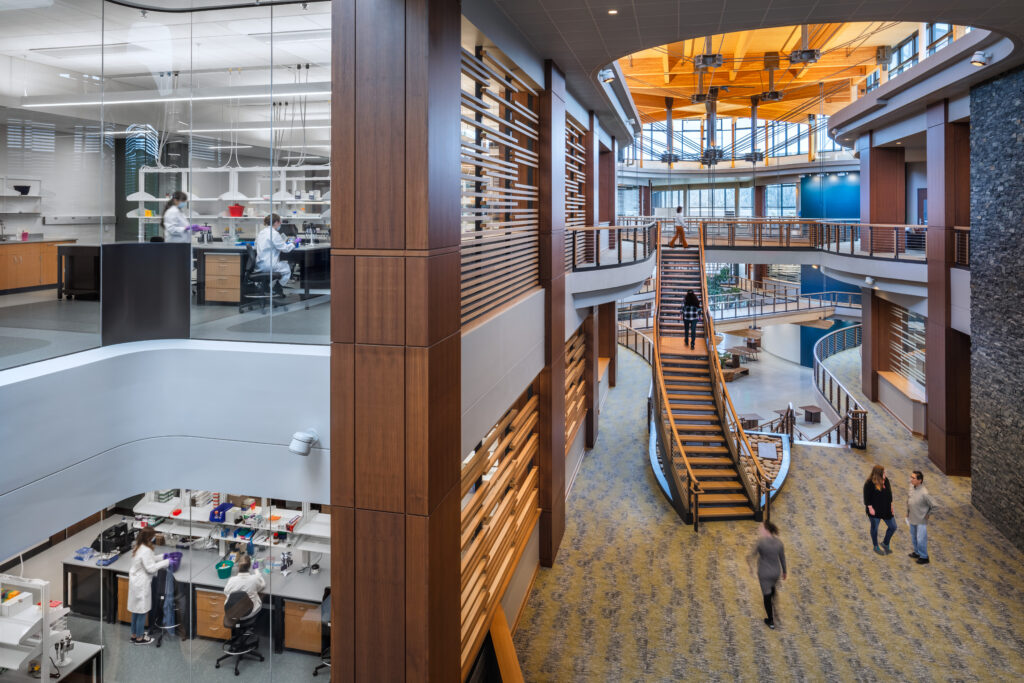
Sarah made her dream a reality when she began leading the Promega R&D Flex Team. This group of diverse research scientists moves around Kornberg Center, contributing resources to accelerate the development of technologies like Lumit Immunoassays and PowerPlex chemistry. They don’t specialize in any field or technology, but rather are constantly challenged to learn new skills quickly. Everywhere they go, they help R&D teams generate more data, answer more questions, and deliver results in less time.
“In short,” Sarah says, “we’re helping research teams make better products, faster.”
Balancing Passion and Results
The Flex Team was launched as the result of a conversation between Sarah and Poncho Meisenheimer, Vice President of Research and Development. However, the idea was born from years of Sarah’s career evolution combining with an organizational unmet need.
As a first-generation college student attending the University of Wisconsin-Madison, Sarah was drawn to a class called “Industrial Microbiology.” She knew she loved science, but this was the first time she thought about how it could be applied to solve real-world problems. That led her to a position in the professor’s lab at the USDA Forest Service, where she got her first hands-on experience with the basics of life science research. From there, she joined Promega as a project employee supporting the development of Maxwell purification chemistry for FFPE samples.
Sarah had performed phenol extractions before, but she’d never touched an FFPE sample or an automated purification system. Thrown into a team with some important products to finish, she quickly learned new techniques and found places to use her skills and perspective.
“I’m not an expert on paramagnetic particles or Maxwell purification,” she says. “I’ve just been exposed to enough things that I was able to come in and help make something happen.”
After that year, Sarah moved around Promega, learning new skills everywhere she went. A job in Operations taught her about genetic identity and techniques like STR analysis and capillary electrophoresis. Six years as a Research Scientist in the Protein and Nucleic Acid Analysis Group led her to bioluminescence and CRISPR, along with emerging fields like targeted protein degradation. Still, while she enjoyed each new opportunity, she never found the passion so many scientists seem to possess.
“I love science, and I always have,” Sarah says. “But I’ve never felt passion for a specific thing. I’ve always known I don’t want to work on the same thing forever.”
In 2021, during his annual State of R&D address, Poncho Meisenheimer took a moment to discuss the importance of balancing passion with marketability. Promega encourages research scientists to pursue ideas that are exciting to them, but Poncho reminded the audience that there also needs to be a business case for the work. Sometimes, he stated, you had to put aside passion for the sake of results.
“That idea stood out to me,” Sarah says, “All the career paths that have been carved rely on people having a passion and becoming an expert in a specific area. I can’t strive for that. It’s not how I work, and it would be disingenuous to myself. So I emailed Poncho and asked if we could chat.”
Sarah told Poncho that she wasn’t sure where she fit in the world of science, but that his comments resonated with her and she was curious what the idea would look like in practice.
“He told me he had an idea that had yet to come to fruition,” she recalls, “for a cross-trained research team that could move around to projects where more resources were needed. Maybe not every week, but no more than a few months at a time getting high-priority projects across the finish line. He asked me if I’d be interested in leading a team like that. And I said, ‘Hell yeah!’”
Recruiting for a Unique Opportunity
The duo drew up official plans for the Flex Team. Sarah would manage a group of Research Scientists from any background or discipline. They would help different groups expedite the timeline of a project with a strong business case, spending no more than six months with each one.
It was an exciting idea, but the next challenge was filling the team. How do you recruit scientists who will have to learn something entirely new several times a year? As it turns out, Sarah’s enthusiasm for change is more common than it seems.
“I’ve never been tied to one area,” says Amanda Marquard, who joined the team in 2023. “I get restless or bored easily, so I was drawn to the opportunity to go on different high-profile projects.”
Amanda’s background includes some pharmaceutical work for a Contract Research Organization (CRO) and several years in Promega Manufacturing. Her first project with the Flex Team is discovery-phase research with the Advanced Technology Group that has challenged her to learn quickly while also leaning on the skills and knowledge she’s picked up along the way.
“I’ve done previous work in protein purification, and I’ve been able to suggest different processes that could be integrated with the current project workflow,” she says. “This job gives you the opportunity to harness your knowledge and try it out in a new context.”
Another team member, Paula Sequeira, says she enjoys being in a constant state of learning.
“There’s a bit of anxiety every time a new project comes along, but in an exciting way,” she says. “I like the part where you have to study for the project – learn everything you need to know to get started.”
The team has now grown to five Research Scientists, with a sixth starting soon. Sarah and Poncho have also discussed long-term hopes to double or triple the size of the team as investment in R&D continues to grow. Sarah says each time she hires someone new, their skills are less important than the mindset they bring in.
“Hire for attitude, train for aptitude,” she says. “We can teach people how to run new assays. It’s harder to teach somebody to be more curious or agile. I’m looking for someone with a growth mindset who is comfortable being uncomfortable.”
“The traditional research scientist path isn’t for everyone,” Paula adds, echoing Sarah’s comments to Poncho. “I think I could find a specialty, but I don’t have a strong desire to. You’ll never become a subject matter expert working on this team, but you’ll grow in so many different areas.”
Better Products, Faster
Two years after its inception, the Flex Team has contributed to seven different projects throughout Promega R&D. One of the first was the validation of the first 8-color STR chemistry, which eventually became the PowerPlex 35GY System.
“Despite not having any STR-specific background, it didn’t take long for the Flex Team to get up to speed and contribute to our verification experiments,” says Michael Lauck, a research scientist in the Genetic Identity Group. Michael witnessed the Flex Team balancing allelic ladder fragments for the PowerPlex 35GY System and preparing reagents to be transferred to Manufacturing. “Overall, their contributions significantly helped us speed up our launch timelines.”
Another recent project required team members to learn about Lumit technology – one of the newest luminescent tools in the Promega portfolio. The first Lumit Cytokine Immunoassays were launched in early 2022, and there were already plans to develop several more. The Flex Team was asked to help label antibodies and functionally test them with specific targets. By the end of the project, they had surpassed expectations and gone above and beyond the original project goals.
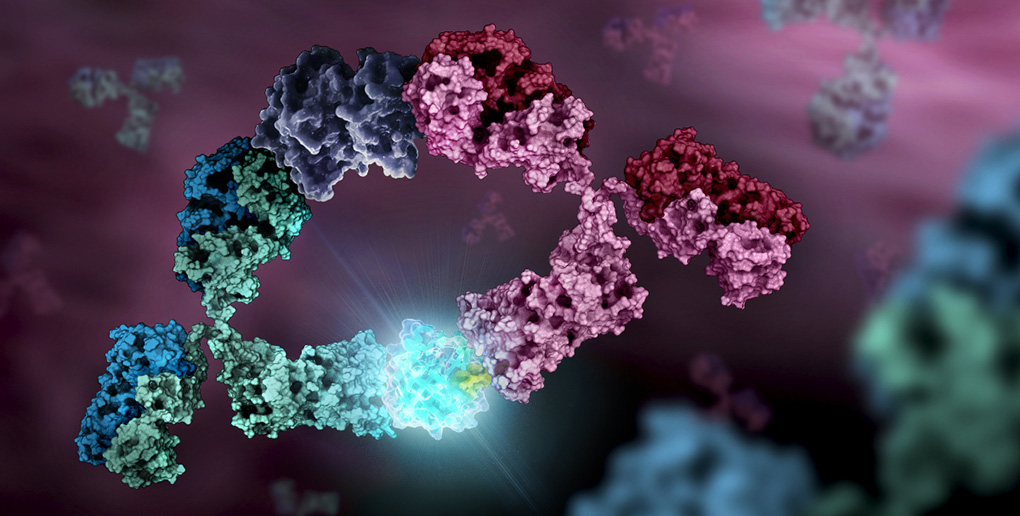
“I understand that their responsibility is to be adaptable when assigned to new projects, but I was blown away by the enthusiasm, collaboration and effectiveness of this group,” says R&D Group Leader Dan Lazar, whose group develops the Lumit Immunoassays. “This was ultimately reflected in the team meeting all goals and, in addition, helping to established improved methods for analysis of labeled antibodies as well as higher-throughput functional testing in 384-well format. They delivered several new assays that have been taken up by the New Product Development team, including two assays already available through Early Access.”
Looking forward, Sarah hopes the team can be a model of agility for teams throughout Promega. As she points out, there’s no template for her team to follow, no examples they can look to for advice. They work together to deepen their skills in communication, conflict management, collaboration, and other tools that are critical for seamlessly joining their colleagues on common goals. While each new project comes with concrete goals and deliverables, they’re able to envision their own picture of growth and success.
“We’re challenging what it means to be a successful scientist,” Sarah says. “We don’t own anything, we aren’t experts in any technology area. Sure, we’ll always need subject matter experts to lean on. But with a motivated team that’s ready to learn, we’re answering more questions and delivering results faster.”
Looking for your next opportunity? Check out the Promega Careers page!