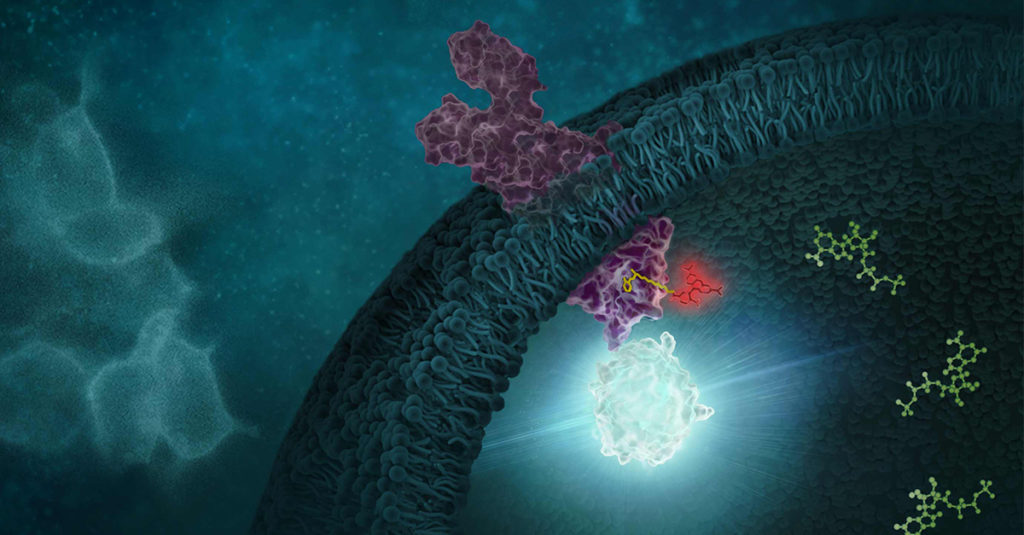
This blog was written by guest contributor Tian Yang, Associate Product Manager, Promega, in collaboration with Kristin Huwiler, Manager, Small Molecule Drug Discovery, Promega.
During the development of chemical probes or small-molecule drugs, compound affinity (Kd) or potency (IC50) is used to characterize compound-target interactions, to guide structure-activity relationship analysis and lead optimization and to assess compound selectivity.
However, neither parameter provides information on how quickly a compound engages with and dissociates from the target. The dissociation constant Kd reflects the relative concentrations of unbound and bound state of the compound at thermodynamic equilibrium, and while IC50 is an empirical metric that measures the concentration at which a biochemical or cellular process is reduced to half of the maximum value, IC50 values are typically determined when the process is assumed to be at equilibrium or steady-state. For a closed system, like cells in a culture dish, these thermodynamic parameters are quite informative. In an open system like the human body, where compound-target interactions often do not reach equilibrium, the kinetic parameters, in addition to the thermodynamic parameters, are needed to better understand and characterize compound target engagement over time (1,2).
Continue reading “Residence Time: The Impact of Binding Kinetics on Compound-Target Interactions”