St. Patrick’s Day means different things depending on where you are in the world. In Ireland, it’s a national holiday steeped in culture and tradition: parades, traditional music sessions and, for many, a pint of Guinness accompanied by a hearty “Sláinte” are all part of the day. Here in the American Midwest, we tend to turn that same spirit into a full spectacle. Green everything as far as the eye can see, including somehow an entire river.
Whatever your version of the holiday looks like, there is a lot of fun science behind it. Here is a look at Midwest St. Patrick’s Day through a lab lens.
The Chicago River: Where Orange Becomes Green
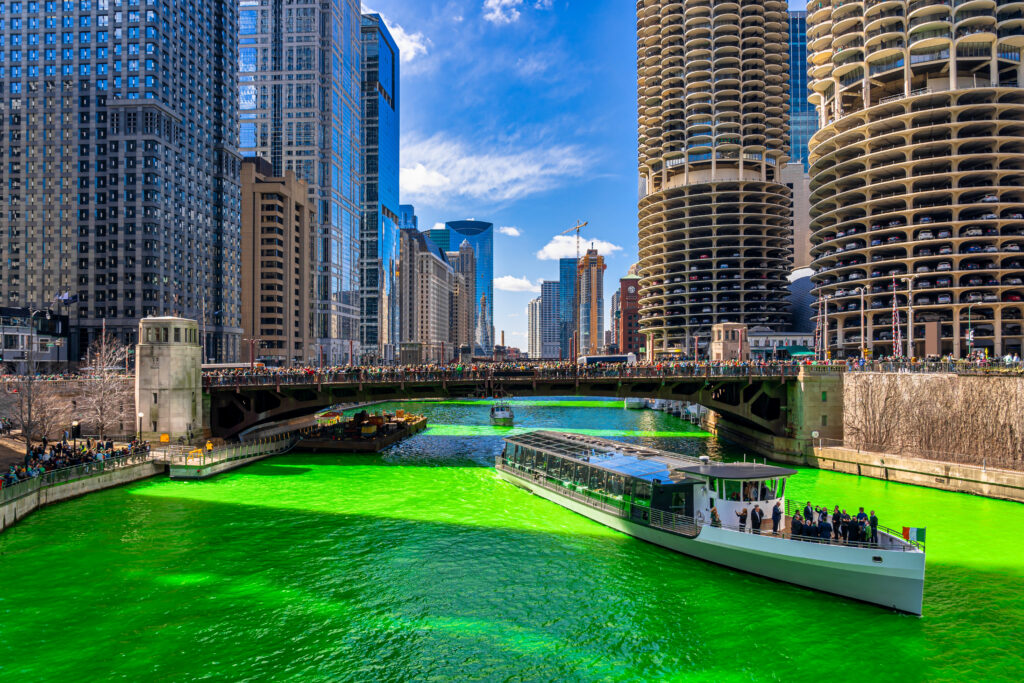
Every St. Patrick’s Day, the Chicago Journeymen Plumbers Local 130 heads out on the river and, in roughly 45 minutes, turns a stretch of the Chicago River a surreal emerald green (7, 11). The twist: the dye goes in orange.
The tradition dates to the early 1960s, rooted in a practical idea. Dye had been used to trace leaks and flow in the city’s waterways and someone realized the same concept could be repurposed into a public spectacle (7,11). The exact formula has been kept secret ever since, described only as environmentally friendly and designed to fade after a few hours (1,7,11).
Continue reading “Some St. Patrick’s Day Science: Green Rivers, Four-Leaf Clovers and Optics of a Good Pint”